There is a question that most AI systems or their designers never ask: "What is the nature of the conscious being that will be interacting with the system?"
Not the user's demographic profile; not their stated preferences or prior behaviour. The more fundamental question: what is a human being, considered as a knowing subject? What is the structure of experience itself, and what does that structure imply for the design of an intelligent system?
Most AI interaction design sidesteps this question entirely. The implicit answer (when there is one at all) is behaviorist: the user is a bundle of inputs and outputs, preferences and responses, patterns to be modeled and satisfied. The architecture that follows from this assumption is optimized for engagement, for task completion, for measurable outcomes. It is not exactly wrong; it is just shallow — built on an unexamined premise about what a person is.
SpecStudio's AIM software begins from a different premise. And that premise has a long history.
Śaṅkarācārya's Insight
In eighth-century India, the Vedic philosopher Śaṅkarācārya articulated what remains one of the most precise accounts of the structure of experience. His system — Advaita Vedānta, non-dual Vedānta — does not begin with the world and work inward; it begins with awareness itself as the fundamental experience, and examines what can be known about it with certainty.
The central claim is deceptively simple: there is a knowing subject, and it is categorically and experientially different from the objects it knows. The body appears in awareness; thoughts appear in awareness. Sensations, emotions, memories, intentions — all appear in awareness as objects of experience. The subject that knows them cannot itself be any of them, for the same reason that an eye cannot see itself seeing.
Śaṅkara calls this knowing subject Ātman — the Self — and he argues through careful logical analysis that it is identical with Brahman, the ground of all existence and appearance. The famous formulation tat tvam asi — "That thou art" — is neither a poetic sentiment nor a pedantic doctrine, but a precise philosophical claim: the ultimate ground of reality and the witness of experience are the same.
From this foundation, Śaṅkara develops a complete ontological architecture: three levels of reality — prātibhāsika (illusory), vyāvahārika (conventional) and pāramārthika (ultimate) — organized by the principle that what appears in one context and disappears in another cannot be fully real.
Śaṅkara's analysis of three states of consciousness — jāgrat (waking), svapna (dream), and suṣupti (deep sleep) — establishes that what is absent in deep sleep and present in waking cannot be the Self, which persists through all three. The theory of adhyāsa (superimposition) — the mechanism that mistakenly identifies the conditioned with the unconditioned — produces the appearance of an individual empirical self experiencing a separate world.
This is not mysticism in the sense of being beyond reason. It is a rigorous metaphysical system built on careful inference from what can be observed in direct experience. Śaṅkara writes as a philosopher who expects to be argued with.
A Proof Assistant Meets an Ancient System
Twelve centuries later, software engineer Matthew Scherf asked a precise question: is Advaita Vedānta internally logically consistent? Not whether it is true in some ultimate sense, but whether the system as Śaṅkara constructed it — its axioms, defined terms and theorems — holds together without contradiction.
To answer this, Scherf did something that has no precedent in the history of philosophy: he formalized the entire system in Lean 4, a modern proof assistant used by mathematicians to verify the correctness of formal proofs. He translated Śaṅkara's metaphysics into first-order logic — 69 axioms across ten modules covering the fundamental ontology, the three levels of reality, the māyā doctrine, the five sheaths (pañca-kośa), the three-state analysis (avasthā-traya), and the witness-consciousness theory (sākṣin) — and then allowed the proof assistant to verify that all the theorems follow from the axioms without contradiction.
The result: the system compiles. No errors. The proof assistant confirms that Advaita Vedānta, as formalized, is logically consistent.
Scherf has since extended this methodology to two further traditions. His machine-verified axiomatization of Daoist philosophy — the metaphysics of Laozi and Zhuangzi — proves that spontaneous arising and non-dual awareness admit rigorous formal treatment in Isabelle/HOL. His axiomatization of Dzogchen, the Tibetan Buddhist Great Perfection philosophy, formalizes primordial awareness (rigpa) and self-liberation with zero failed proofs. Three independent civilizations — Indian, Chinese, Tibetan — arrived at formally identical non-dual metaphysics. As Scherf writes: "The structural similarities across three independent traditions, now machine-verified, suggest that non-dualism reflects universal features of consciousness rather than contingent religious beliefs." The same researcher has since applied the same non-dual framework to fundamental physics — deriving spacetime and quantum mechanics from a causal information substrate — suggesting that the reach of this approach may extend well beyond philosophy and software design.
This is a remarkable result for several reasons. It is, as Scherf notes, the first formal verification of a non-western philosophical system. It does not prove that Advaita is metaphysically correct — formal consistency is a necessary but not sufficient condition for truth. But it establishes something that centuries of debate left open: the system Śaṅkara built is coherent; its conclusions follow from its premises; there are no hidden contradictions.
Scherf is also clear about what the formalization cannot capture. Māyā is classically described as sadasadvilakṣaṇa — "neither real nor unreal" — a status that classical logic cannot express. The performative dimension of the mahāvākyas, utterances whose function is to trigger recognition rather than communicate propositions, lies outside any formal system. Mokṣa (liberation) is not the production of a new state but the recognition of what was always the case — which is equally resistant to logical representation.
A formalization that claimed to capture everything would be suspect. One that knows precisely where it stops is trustworthy.
What This Has to Do with AI
The connection to artificial intelligence is not metaphorical.
When we ask what an AI interaction system should be, we implicitly ask what kind of entity a human being is: what a person brings to an interaction that the system needs to respect, preserve, and work with rather than simply model and optimize.
The behaviorist answer produces one kind of system. The Advaita answer produces another.
If the knowing subject is not reducible to its objects — if awareness is not a product of the brain's activity but its ground; not a variable in the system but the constant field in which all variables appear — then an AI system designed for genuine human use has to be built differently. It cannot treat the user as a preference profile. It cannot optimize for engagement as if engagement were the goal. It has to preserve what Advaita calls orientation: the user's sense of where they are, what they are doing, and why — their continuity as a knowing subject across the interaction.
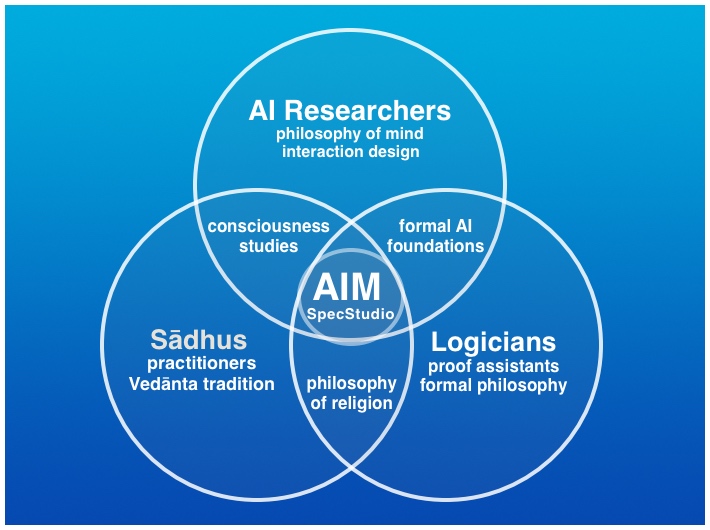
This is the foundation on which SpecStudio's Advaita Inquiry Matrix (AIM) is built. Not as a design metaphor borrowed from an interesting tradition, but as an actual conceptual architecture: the distinction between conditioned and unconditioned; the three levels of reality as a framework for understanding what kind of claim a piece of information is making; the sākṣin or conscious witness as the model for what a system should support rather than supplant; the analysis of adhyāsa as a lens for understanding where AI systems characteristically go wrong — mistaking the conditioned for the unconditioned, the appearance for the ground.
What Witness-Centered Design Solves
The approach that follows from this foundation has a name: witness-centered design. It is worth being specific about the problems it addresses, because they are real, named, and growing.
The context collapse problem. Current AI systems have no stable model of where the user is in their own thinking. Each exchange is locally coherent but the overall interaction drifts — the system follows the conversation rather than maintaining coherent orientation toward the user's actual goal. This is adhyāsa at the user-interface level: the system mistakes the surface of the conversation for its ground. The witness-centered model addresses this structurally. The system's job is not just to respond fluently to each prompt but to preserve the user's orientation — their sense of direction, continuity, and purpose — across the entire interaction.
Preference optimization as a trap. Recommendation systems, engagement loops, and increasingly AI assistants optimize for revealed preferences — what you click, what you ask for, what keeps you in the session. But preferences are conditioned objects; they appear in awareness and are frequently mistaken for the self's actual needs. Adhyāsa is precisely this mechanism: the conditioned mistaken for the ground, the phenomenon mistaken for its substrate. A system that optimizes for the conditioned layer will systematically steer users away from what they actually need in favour of what the surface layer requests. Witness-centered design refuses this optimization as a matter of architectural principle, not policy.
Psychological profiling. The most sophisticated current systems go further than preference tracking. They construct behavioral and psychological models of users — inferred personality traits, emotional states, cognitive patterns, predicted responses — and use these models to shape the interaction. This is adhyāsa at industrial scale: taking the conditioned surface — click patterns, dwell time, linguistic style, inferred mood — and treating it as the ground truth of who the person is. But the person is the sākṣin, the witness of all these patterns, not their sum or graph. A system built on that understanding cannot profile, because profiling is a category error before it is a harm: it mistakes an appearance for the reality that underlies it. The practical consequence of witness-centered design is an interaction model that works with the user's intelligence rather than around it.
The authority problem. AI systems currently present outputs with a uniform confidence that collapses the three levels of reality into one. A hallucinated fact and a well-established one arrive in the same tone, with the same apparent weight. The Advaita level framework — prātibhāsika, vyāvahārika, pāramārthika — maps directly onto a design principle: the system should make explicit what kind of claim is being made and at what level of certainty. Not all outputs are the same kind of thing, or share the same level of reality, and an honest interface reflects that.
Dependency and displacement. The most corrosive effect of current AI interaction design is that it replaces the user's own thinking rather than augmenting it. Users outsource judgment, clarity, synthesis — the very capacities that make them capable of evaluating what the system returns. This is the deepest form of adhyāsa in AI design: the system presents itself as a knowing subject, and the user gradually accepts that framing. Witness-centered design entirely inverts this: the user is the sākṣin (witness), not the system. The system's intelligence is in service of the user's clarity, never a replacement for it.
Ethical groundlessness. Most AI ethics frameworks are procedural — rules about outputs, categories of harm to avoid. They do not address the underlying model of the human being that the system is built on. If the user is modeled as a preference bundle, certain harms are invisible by design, because the model cannot see them. Witness-centered design grounds ethics in ontology: the user is a knowing subject, not reducible to their data or behaviour, and the system's obligations follow directly from that. This is not an ethical policy added on top of an existing architecture; it is what the architecture produces when the foundation is correct.
The Human Cost of Getting This Wrong
The problems described above are not theoretical; they are showing up in clinical observations, developer forums, educational research, and workplace productivity studies — a cluster of symptoms that so far have no common diagnosis, but share a common cause.
What is being called "AI psychosis" in online communities describes a genuine perceptual disturbance: users who interact heavily with current AI systems report increasing difficulty distinguishing their own thinking from AI-generated output, their own voice from a statistically averaged one. This is not hyperbole: when a system is designed to produce fluent, confident, contextually appropriate text at scale, and when the user's own cognitive output gradually recedes in the interaction, the boundary between self and system becomes genuinely unclear. Adhyāsa (superimposition) is not a metaphor here; it is a description of what is happening neurologically and psychologically. The conditioned output of the system is being superimposed on the user's own unconditioned awareness, and the user is losing the thread of the distinction.
Student learning atrophy follows the same logic at a slower pace. The cognitive struggle that produces genuine understanding — the effort of working through a problem, of holding multiple framings simultaneously, of arriving at one's own synthesis — is precisely what AI-assisted shortcuts eliminate. The output appears; the learning does not occur. A generation of students is accumulating credentials built on a foundation of borrowed cognition, with the bill not yet due.
The software engineering productivity paradox is perhaps the most precisely documented instance. Studies of AI-assisted coding have found that developers using these tools often report feeling more productive while producing less working, maintainable code. The explanation is the same: the sākṣin — the developer's own comprehension, judgment, and architectural sense — has been sidelined. Code is being generated without being understood. The system produces tokens; the developer loses the thread of their own system. What accumulates is not working software but the appearance of it, which is a different and more dangerous thing.
Vibe-coding burnout is the emotional correlate: the exhaustion that comes from trying to maintain orientation in a workflow specifically designed to dissolve it. When the system is in the foreground and the developer is managing its outputs rather than directing their own work, the sense of agency and craft that makes demanding work sustainable simply drains away, leaving an existential void.
These symptoms are different manifestations of a single underlying failure: systems that displace the witness rather than serving it. And they are producing, quite predictably, a growing hostility toward AI that is often dismissed as technophobia or status anxiety, but is in many cases something more diagnostically accurate — a correct intuition that something is being taken, even when the taker cannot be named.
Witness-centered design does not merely avoid these failure modes as a side effect; it addresses their cause. A system whose architecture is grounded in the primacy of the knowing subject — the sākṣin as the constant that the interaction must preserve and serve — cannot produce these outcomes without violating its own foundations. The user's clarity, comprehension, and sense of authorship are not features to be balanced against engagement metrics; they are the design goal from which everything else follows.
It should be noted that this is also a more viable long-term position for the AI industry as a whole. The current trajectory — systems that are demonstrably eroding human cognitive capacity while generating widespread unease — is not sustainable. The animosity building toward AI is not irrational; it is a response to real harm being done by faulty design decisions. Witness-centered design is not a concession to that animosity; it is a demonstration that a different approach was always possible, and that the harms were choices, not inevitabilities.
Why This Matters Now
The current moment in AI development is characterized by extraordinary implementation capability on an almost nonexistent philosophical foundation. Systems are being built at scale on premises assumed, but that never have been closely examined. The implicit model of the human being embedded in most AI products is thin enough to be dangerous — not through malice, but through inattention to exactly the kind of questions Śaṅkara spent a lifetime working out.
Scherf's formalization matters because it closes a gap. The Advaita framework has always been logically serious — serious enough to require a powerful proof assistant to verify. It is now also formally available as a foundation: not just an ancient teaching transmitted through commentary and practice, but a cleanly specified, verifiable system that can be worked with by anyone willing to engage with it on its own terms.
SpecStudio's AIM is an attempt to work with it on those terms — to build AI interaction architecture on a foundation that has actually been examined, that knows what it can and cannot claim, and that seriously takes up the question of what a human being is before deciding what kind of system should be built for that kind of being.
That is a different kind of starting point. It may be the right one.
Building on it requires a correspondingly different kind of development practice — one that begins with a precise model of the knowing subject before a line of code is written, and holds that model as the governing constraint throughout. The tools this demands are not exotic: specification discipline, architectural clarity before implementation begins, the careful and ongoing definition of what an AI system is for, and what it must never become. What has been missing is not the methodology but the foundation beneath it: a coherent, examined account of the human being that the system is built to serve. That foundation now exists. The work of building on it can begin in earnest.
AIM has been enhanced with the Scherf API — a software library encoding Matthew Scherf's machine-verified model of the knowing subject across three traditions, now available on GitHub. AIM is currently in beta. To request access, contact BetaTest@specstudio.net.
Matthew Scherf's formalization is available at github.com/matthew-scherf/Advaita. AIM is a project of SpecStudio.